
Young, Tech-Savvy yet Still at Risk of being scammed?
How Scam Vulnerability Differs Across Age Groups in Singapore
Scams are often associated with older and less digitally savvy individuals. However, findings from a recent study of 1,052 Happydotters suggest that vulnerability to scams is not limited to any one age group.
Instead, scam risks vary not just by age, but are also shaped by how people make decisions and respond to situations. Rather than being tied to one demographic, vulnerability also depends on behavioural patterns unique to each group.
Understanding Scam Vulnerability Beyond Age
To better understand what really drives scam vulnerability, we conducted a behavioural study with Happydotters.
Respondents rated 47 statements about their everyday behaviours; from how they make decisions, to whether they take risks, how much they rely on others, and how they process information.
Using statistical analysis, these behaviours were grouped into 10 key traits that reflect how people in Singapore think and act. This approach helps us move beyond basic demographics like age and instead focus on how behaviourial tendencies influence scam risk.
For example, the research found that individuals who seek out new and novel experiences are also more likely to display lower self-control, making them potentially more susceptible to impulsive decisions in scam situations. Those who take financial risks also tend to take ethical risks, forming a broader risk taking pattern that can heighten scam susceptibility.
These findings highlight that it is the combination of behaviourial patterns, rather than just age alone; that shapes an individual’s level of scam risk.
By using this behavioural framework, we can better identify which traits heighten scam vulnerability, thus design targeted interventions and safeguards that help individuals recognise and avoid scams more effectively.
Ultimately, this approach shifts the focus from just demographic stereotypes to also underlying behavioural mechanisms as well that contribute to risk, empowering individuals to recognise and mitigate their own susceptibilities to scams.
Younger Singaporeans: Higher Risk-Taking and Sensation- Seeking
Respondents aged 15 to 34 show distinctive behavioural patterns that set them apart in terms of scam vulnerability. According to the behavioural study, this age group tends to score higher on risk-taking behaviours, sensation-seeking tendencies. These traits reflect a greater willingness to explore new experiences and embrace uncertainty.
These behavioural characteristics are closely linked to a heightened likelihood of acting on time-sensitive opportunities, and engaging with new or unfamiliar platforms. As a result, their risk-taking behaviour and openness to novelty can increase their exposure to scams, particularly those that leverage urgency, and unfamiliarity, to prompt impulsive actions.
This is reflected in how believable certain scam scenarios appear:
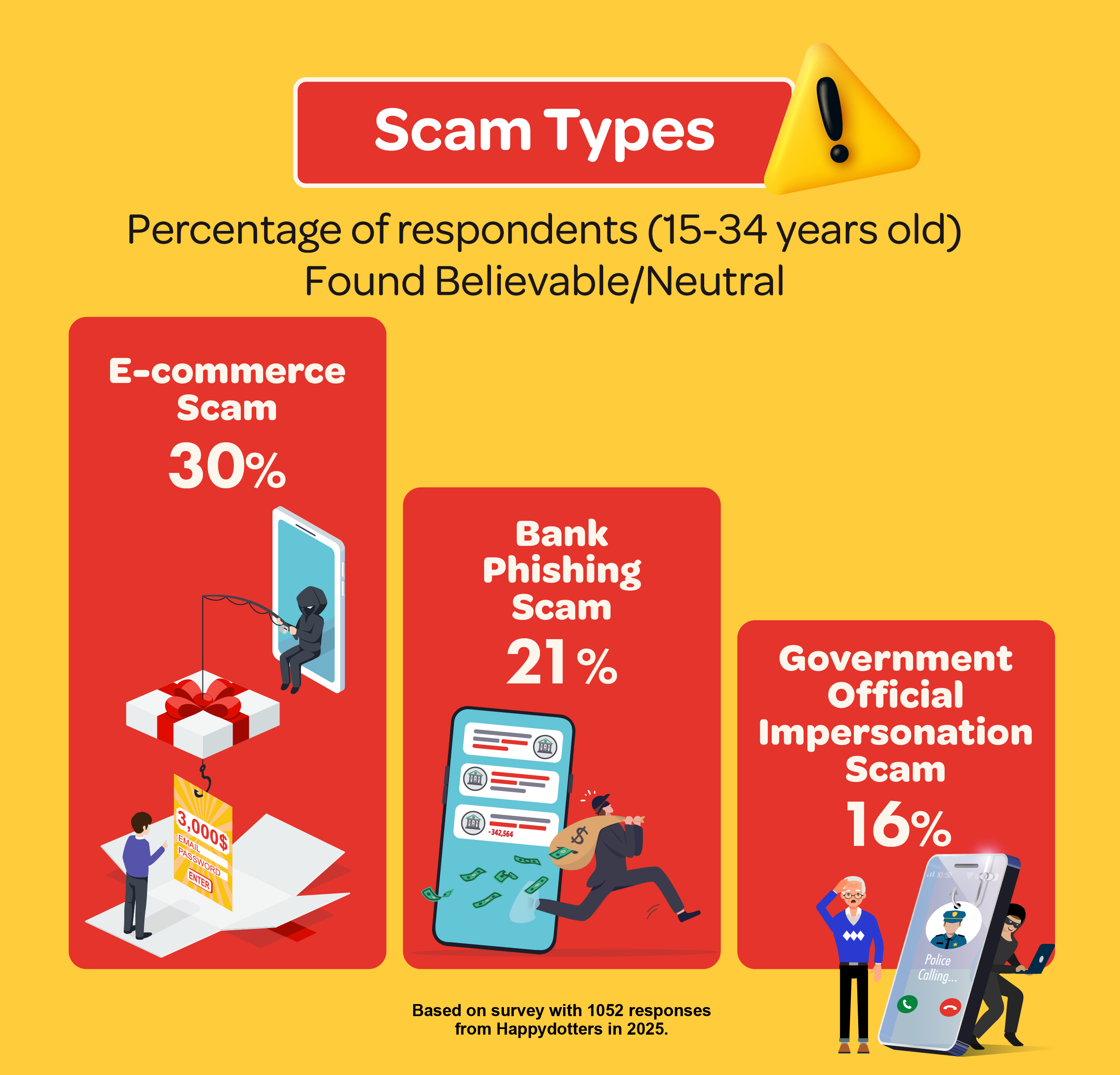
While younger individuals are generally more digitally confident, these behavioural tendencies may lead to faster decision-making and lower caution in high-pressure situations.
Older Singaporeans: Lower Risk Appetite, Lower Discernment
Respondents aged 45 and above generally display lower risk-taking tendencies and more cautious decision-making behaviour.
However, they face a different challenge, a difficulty in distinguishing between legitimate and scam messages.
This was measured using a Message Discernment Score, which reflects the difference between how believable real messages seem and how believable scam messages seem. A higher score means respondents can clearly tell real from scam, while a lower score means the difference becomes harder to spot.
Scores decline with age:
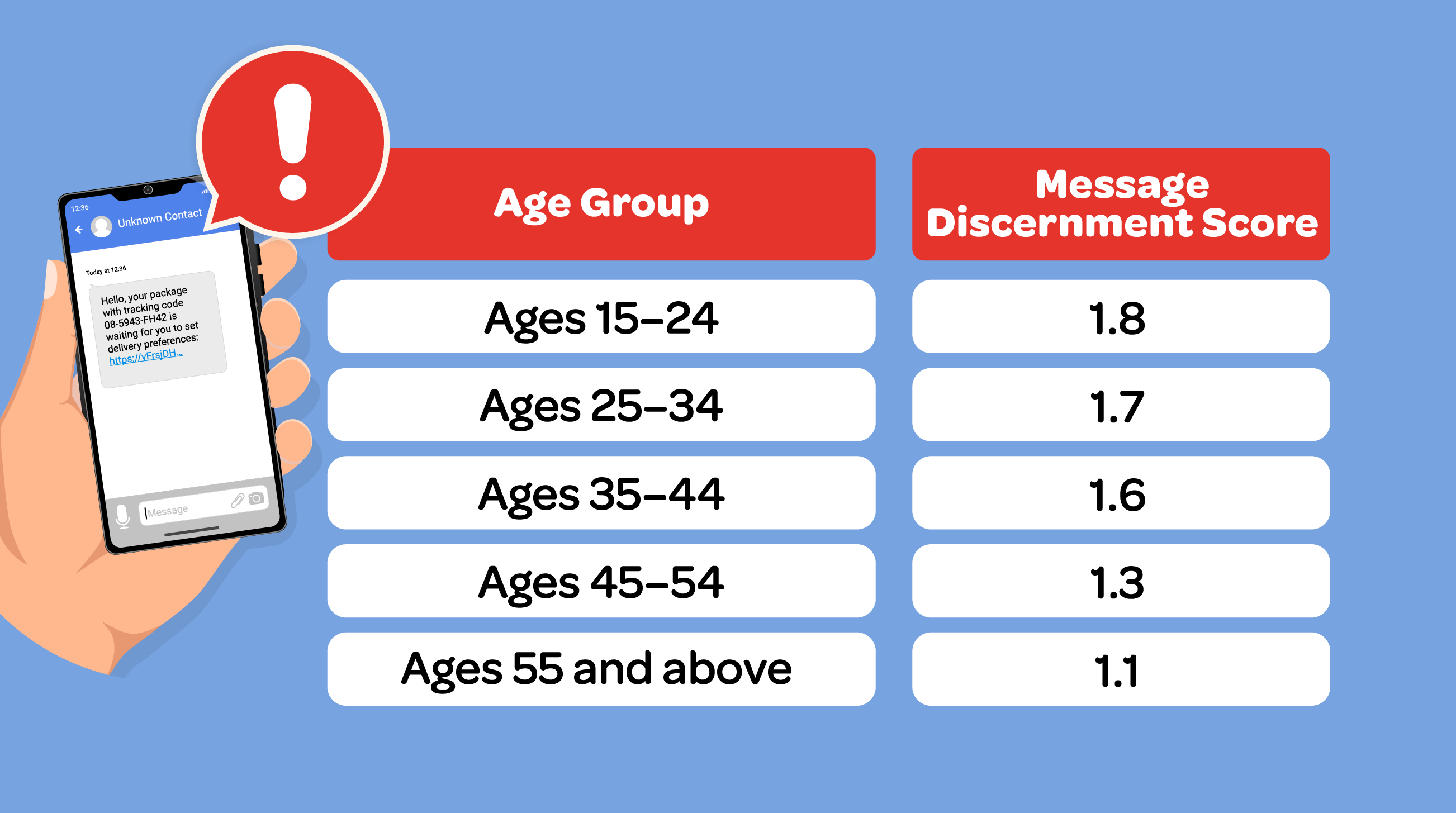
This suggests that older individuals may be less familiar with evolving scam formats, often rely more on surface cues such as logos or tone, and are more susceptible to messages that appear to come from trusted authorities.
Different Vulnerabilities Across Age Groups and approach to Scam Prevention
The findings highlight that scam vulnerability manifests differently across age groups:
Individuals aged 15 to 34 tend to be more susceptible to scams due to factors such as higher risk-taking behaviour, and sensation-seeking tendencies, This demographic is more likely to engage with fraudulent schemes and often acting impulsively. Their vulnerability is shaped by behavioural patterns that prioritise immediate action, making them targets for scams that exploit these characteristics.
In contrast, those aged 45 and above face challenges in discerning authentic messages from scams. This group exhibits lower message discernment and is more likely to misidentify fraudulent communications as legitimate, often relying on surface cues such as logos or authoritative tone. Their vulnerability stems from a tendency to trust messages that appear official or familiar, making them more susceptible to sophisticated scam tactics that mimic trusted sources.
These insights demonstrate that vulnerability to scams is not uniform, indicating that no single group is fully protected, and that vulnerability is shaped by a combination of behavioural and cognitive factors.
Implications for Scam Preventionn
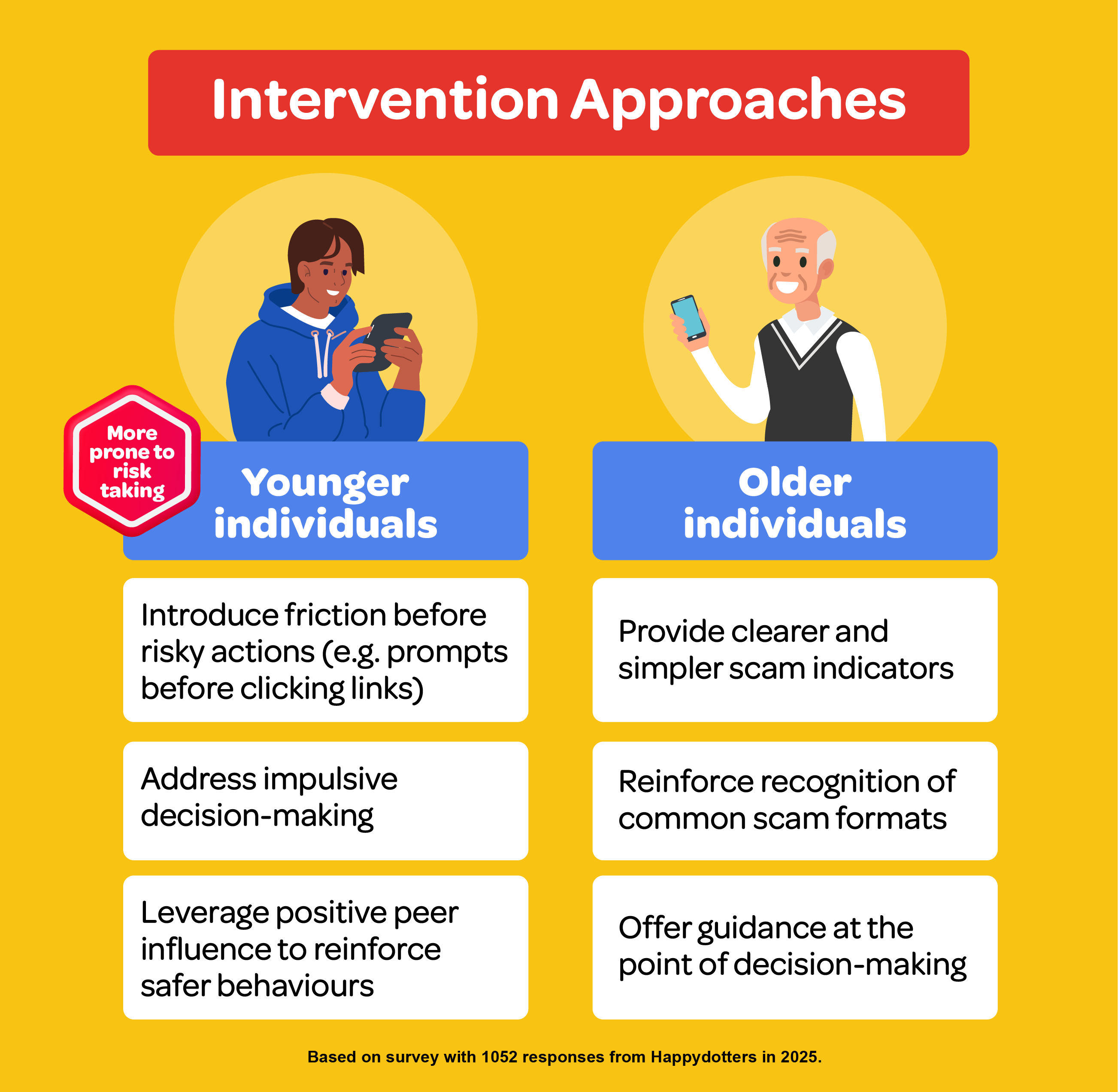
Given these differences, a one-size-fits-all approach to scam prevention may not be effective.
Instead, interventions could be tailored accordingly to different age groups and behaviourial tendencies as such:
Why this matters to Scam Prevention
Scam vulnerability is not just a matter of age or digital ability, it is shaped by how individuals think, respond, and make decisions in different situations.
Younger individuals may be more digitally confident and tech-savvy but they are also more likely to take more risks and act (too) quickly. Older individuals, while more cautious, may face greater difficulty in distinguishing between legitimate and fraudulent messages.
These differences highlight an important point of view: effective scam prevention is not just about raising awareness but addressing the specific behavioural patterns that shape how different groups respond to scams.
Share your views on ongoing social issues in Singapore through our surveys and check out fresh insights of What Singapore Thinks every month!
Mingle with other HappyDotters! LIKE our Facebook and FOLLOW our Instagram to know more about us.