
Raising the Next Generation: What Singaporeans Value and What Worries Them Most
In an increasingly complex world, what do adults believe children need most to thrive? And how do today’s biggest concerns shape these priorities?
Our Year in Review survey findings reveal a clear link between the values Singaporeans want to pass on and the challenges they feel most acutely.
Responsibility Comes First
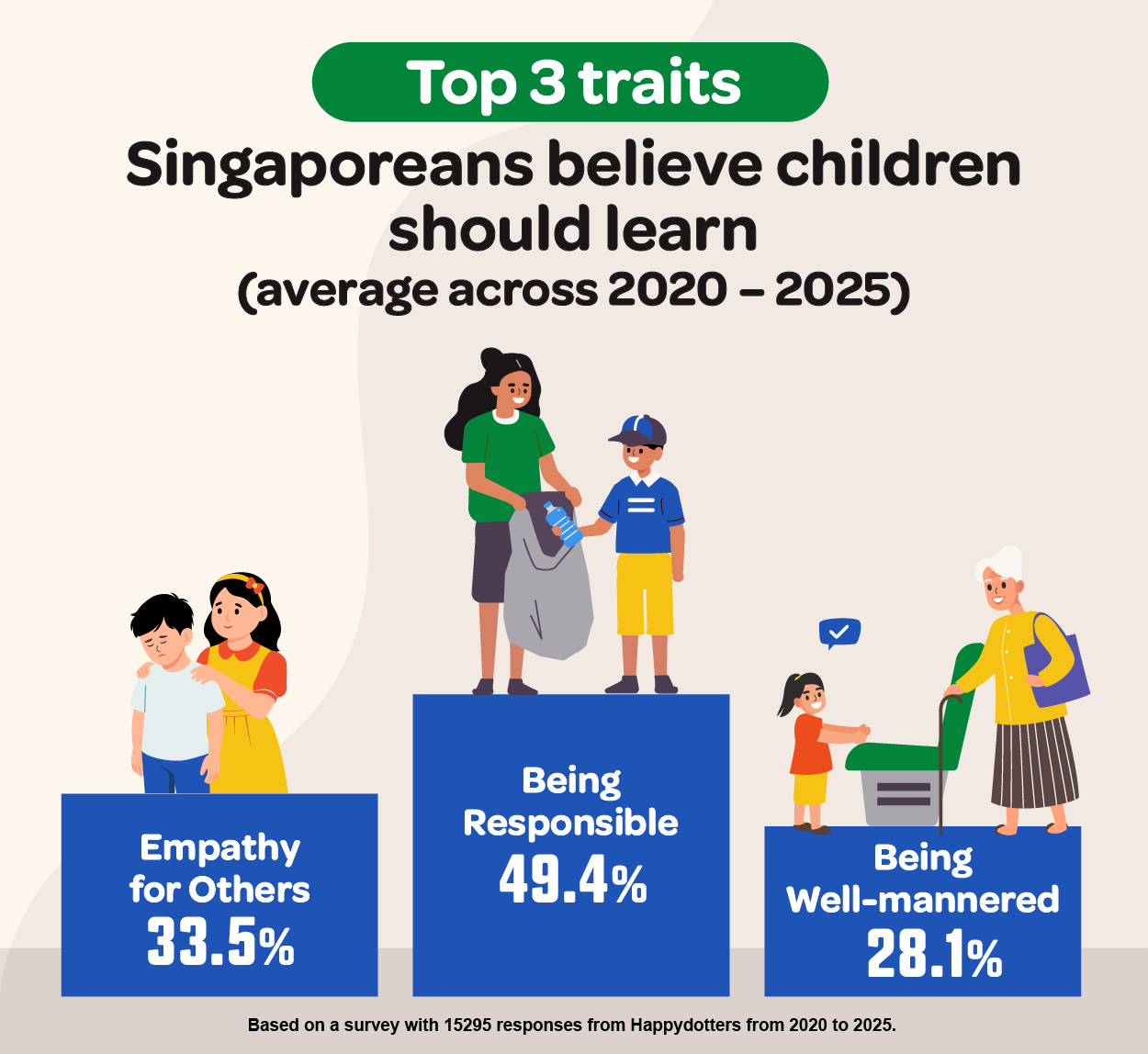
Across every survey year from 2020 to 2025, being responsible stands out as the top trait Singaporeans believe children should learn – rising slightly from 48.9% in 2020 to 50.5% in 2025. In a fast-paced society where individuals are expected to manage both personal and social obligations, responsibility appears to be viewed as a non-negotiable life skill.
Close behind is empathy for others, chosen by an average of 33.5% Happydotters each year, peaking at 39.0% in 2021. This signals a strong desire for children to grow up socially aware and considerate of others— especially in a diverse, interconnected society like Singapore.
Good Manners, Independence, and Hard Work Still Matter
Traditional social values continue to hold their ground. Being well mannered increased from 28.1% in 2020 to 30.2% in 2025, while independence stayed consistently important to an average of 25.4% of Happydotters through 2020 to 2025. Meanwhile, hard work remains a steady priority for an average of 18.1% over the years.
Creativity and Curiosity Take a Back Seat
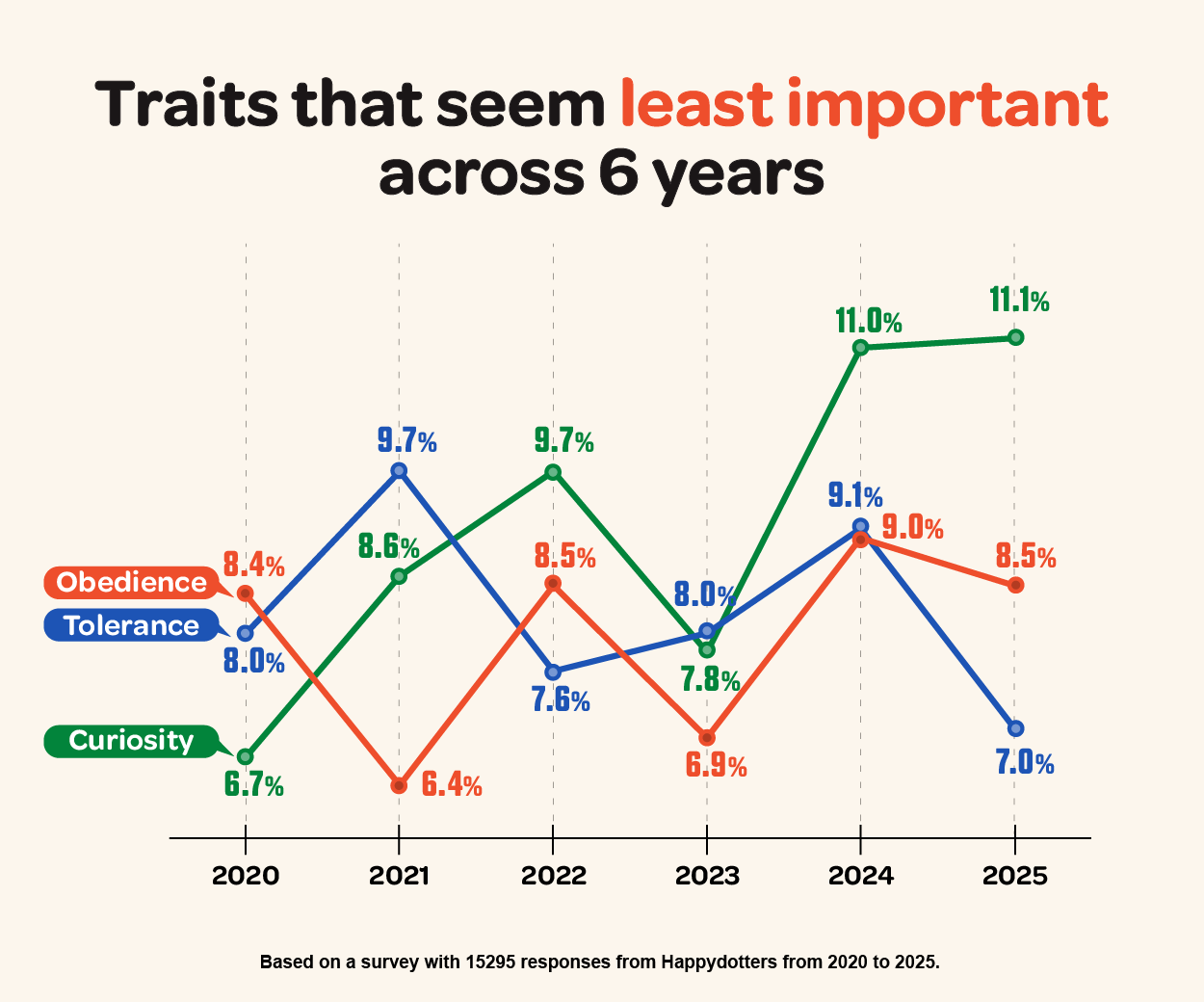
While often championed in education discourse, traits like creativity and curiosity receive comparatively less emphasis from Happydotters. Creativity remains below 11.0% across all years, while curiosity rises modestly from 6.7% in 2020 to 11.1% in 2025. Tolerance and Obedience similarly stay under 10% throughout the years too.
These patterns suggest that in the eyes of many adults, softer or exploratory traits are seen as “nice to have”, but less critical than strong moral grounding and social responsibility.
Why These Values Matter: A Look at What Worries Singaporeans
The findings on what crisis are of greatest concerns to Happydotters shed light on why responsibility and empathy may matter more than ever. When uncertainty becomes a constant backdrop, the qualities people hope to instil in children shift from aspirational to essential.
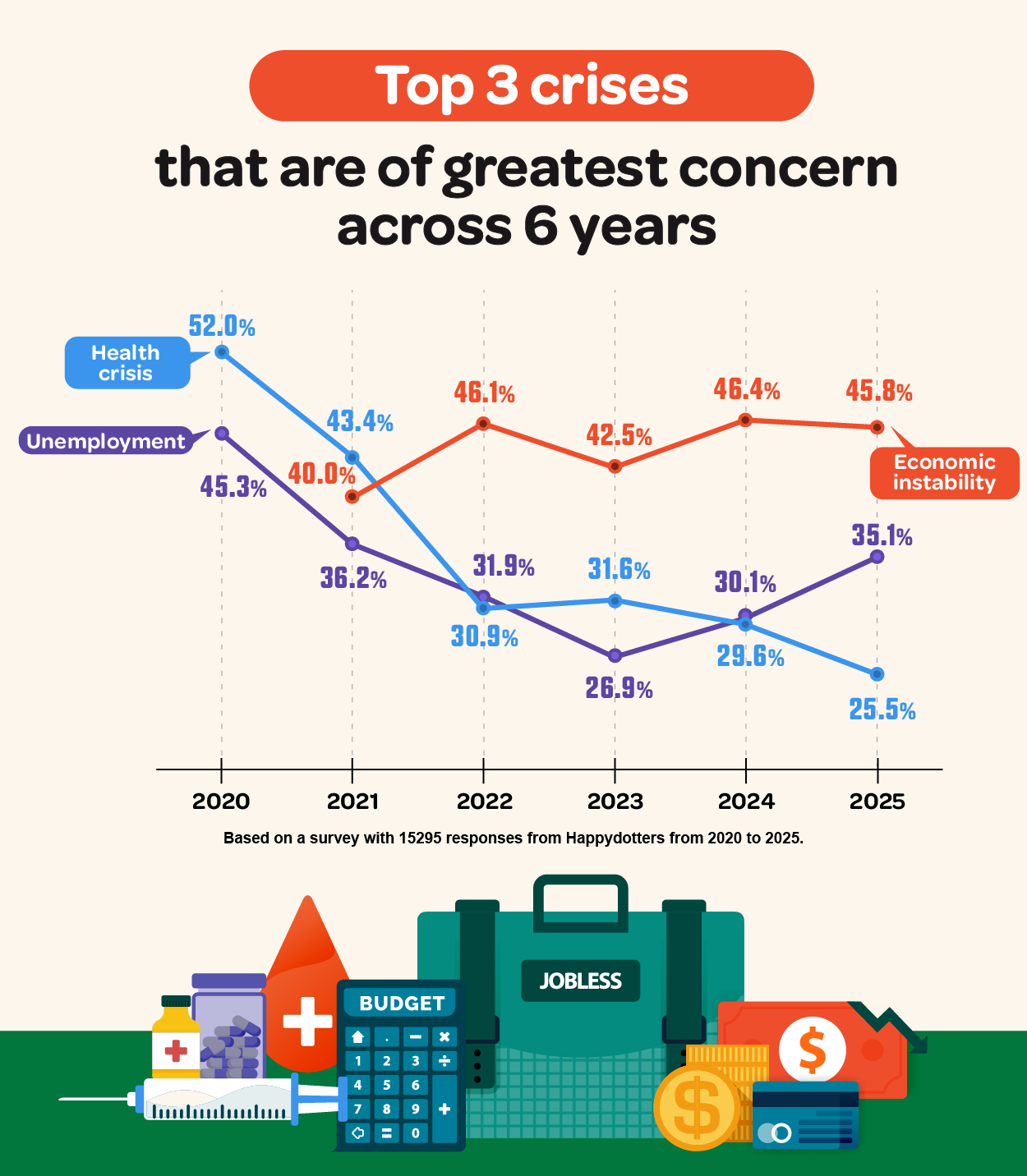
Economic instability has emerged as a growing concern amongst HappyDotters, rising from 40.0% in 2021 to 45.8% in 2025, while unemployment has remained persistently high, affecting an average of 34.2% of HappyDotters between 2020 and 2025. In an environment where financial security cannot be taken for granted, responsibility and independence are seen as crucial traits—qualities that equip children to adapt, persevere, and take ownership of their futures.
Although concern about health crises has eased since its peak of 52.0% in 2020 no thanks to COVID-19, it still affects 25.5% of respondents in 2025. Concern over climate change remains consistently high, rising from 24.9% in 2020 to 31.8% in 2021, and hovering back at 25.2% in 2025. Everyday security issues also remain top of mind where crime concerns an average 24.0% of HappyDotters across the 6 years.
Together, these challenges highlight why responsibility and empathy matter—not just for social harmony, but for collective resilience.
The Bigger Picture
Taken together, the findings suggest that Singaporeans’ parenting values are deeply shaped by the realities they face. In a world where economic instability, unemployment, and health risks dominate public concern, raising children who are responsible, empathetic, and well mannered is seen to future proof the next generation.
These traits go beyond moral ideals. They reflect practical life skills where helping children navigate uncertainty, contribute positively to society, and respond thoughtfully to an unpredictable future.
Share your views on ongoing social issues in Singapore through our surveys and check out fresh insights of What Singapore Thinks every month!
Mingle with other HappyDotters! LIKE our Facebook and FOLLOW our Instagram to know more about us.